Early Finish Date (EF)

In critical path method scheduling, the EF is the earliest time the remaining work of an activity could complete, based on the network logic, the current data (status) date, and any schedule constraints.

Key Points

  • Computed during the forward pass: EF = ES + activity duration, adjusted for calendars, lags, and constraints.
  • Refers to the uncompleted portion of the activity and cannot be earlier than the data date for future or remaining work.
  • EF values drive successor timing; a successor's ES depends on predecessor EFs and relationship lags/leads.
  • On the critical path, early and late dates coincide (EF = LF), yielding zero total float.

Example

An activity "Design" has a 5-day duration, no predecessors, and the data date is Monday, May 5. Using a 5-day workweek calendar, ES = May 5 and EF = Friday, May 9. A successor "Build" with a finish-to-start relationship can begin the next working day after EF, which is Monday, May 12.

PMP Example Question

During a forward pass, how is an activity's Early Finish Date (EF) determined?

  1. By subtracting total float from the Late Finish.
  2. By adding the activity duration to the Early Start and applying calendars, lags, and constraints.
  3. By taking the minimum EF of all successor activities.
  4. By selecting the earliest date resources are available.

Correct Answer: B — Add duration to Early Start and account for calendars, lags, and constraints

Explanation: EF is a forward-pass calculation based on network logic and timing rules; it is not derived from float, successors, or resource availability alone.
AI for Agile Project Managers and Scrum Masters

Become an AI-first leader and transform your agile practice by leveraging artificial intelligence as your most powerful co-pilot. This course is designed to help you drive efficiency, insight, and innovation, ensuring you stay at the forefront of a rapidly evolving project management landscape.

This isn't about replacing human intuition—it's about augmenting it. You'll master prompt engineering to automate mundane tasks, freeing up your time for high-impact strategic leadership and creative problem-solving. Learn to refine backlogs, create strategic roadmaps, and integrate AI seamlessly into your agile ceremonies.

Gain predictive power by using AI-driven insights to anticipate project risks and seize new opportunities for more reliable outcomes. We deliver practical, prompt-based workflows and proven strategies built around real-world agile challenges that you can implement immediately within your framework.

Master foundational AI concepts specifically relevant to Scrum environments while developing advanced skills to handle diverse agile scenarios. You will learn to champion an AI-enabled culture within your organization, fostering a dynamic environment of continuous improvement and superior team delivery.

Ready to lead the future of agile and make data-driven decisions that cut through complexity? Join a community of forward-thinking professionals and position yourself as an indispensable leader in the AI era. Enroll now and unlock your future!


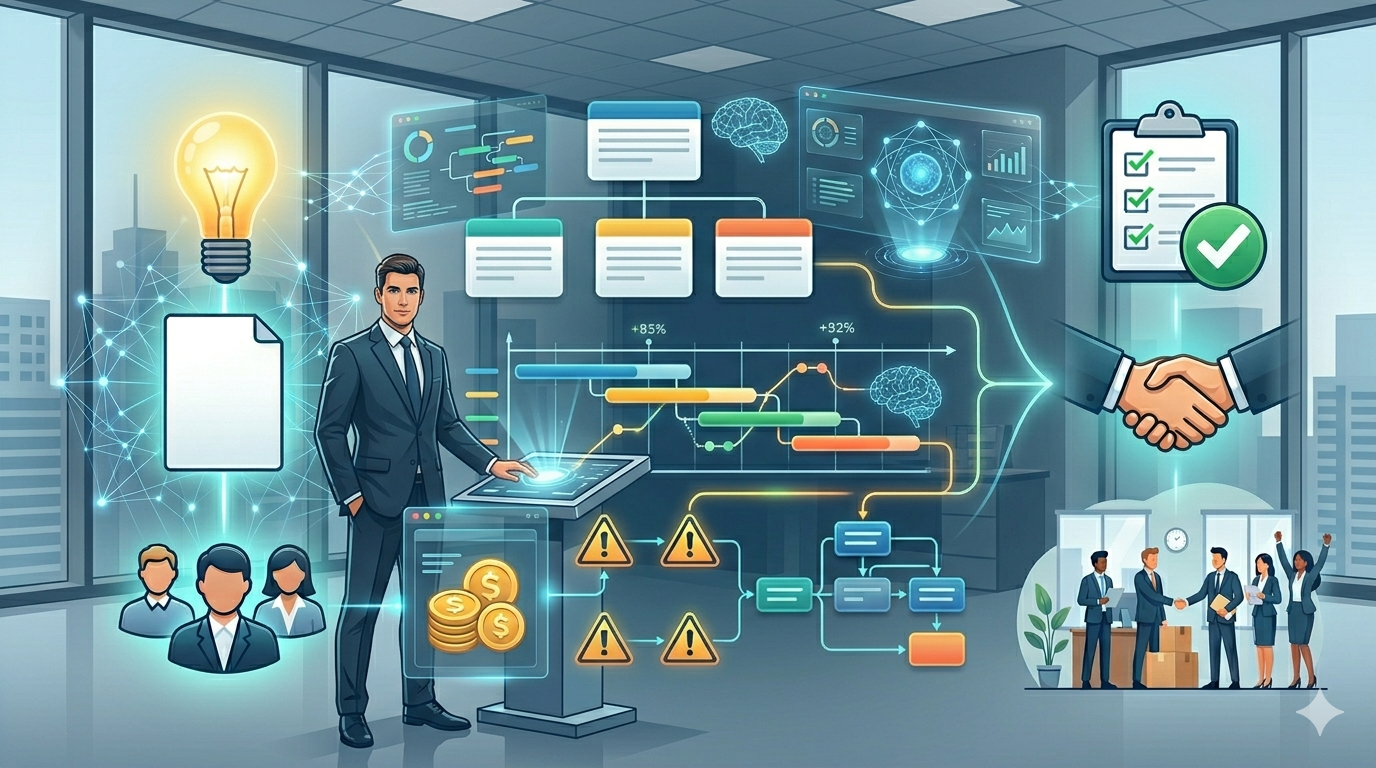
Build complete project plans in minutes with AI

Stop spending hours on documentation. Learn how to use AI to create charters, WBS, schedules, risk registers, and executive reports faster—while staying fully in control. This course gives you ready-to-use prompt templates and practical workflows based on real project work. No guesswork, no fluff—just tools you can apply immediately. Backed by Udemy’s 30-day money-back guarantee, so you can start risk-free.

Learn More