
The ICS Security Landscape
IT versus OT, the five myths, risk, defence in depth, IEC 62443 and NIST for ICS, with Stuxnet and Triton.
ICS/OT Cybersecurity Fundamentals
The defensive foundation for industrial systems, built on IEC 62443: zones and conduits, OT-safe monitoring, incident response and risk assessment, explained for people from the plant floor and from IT.
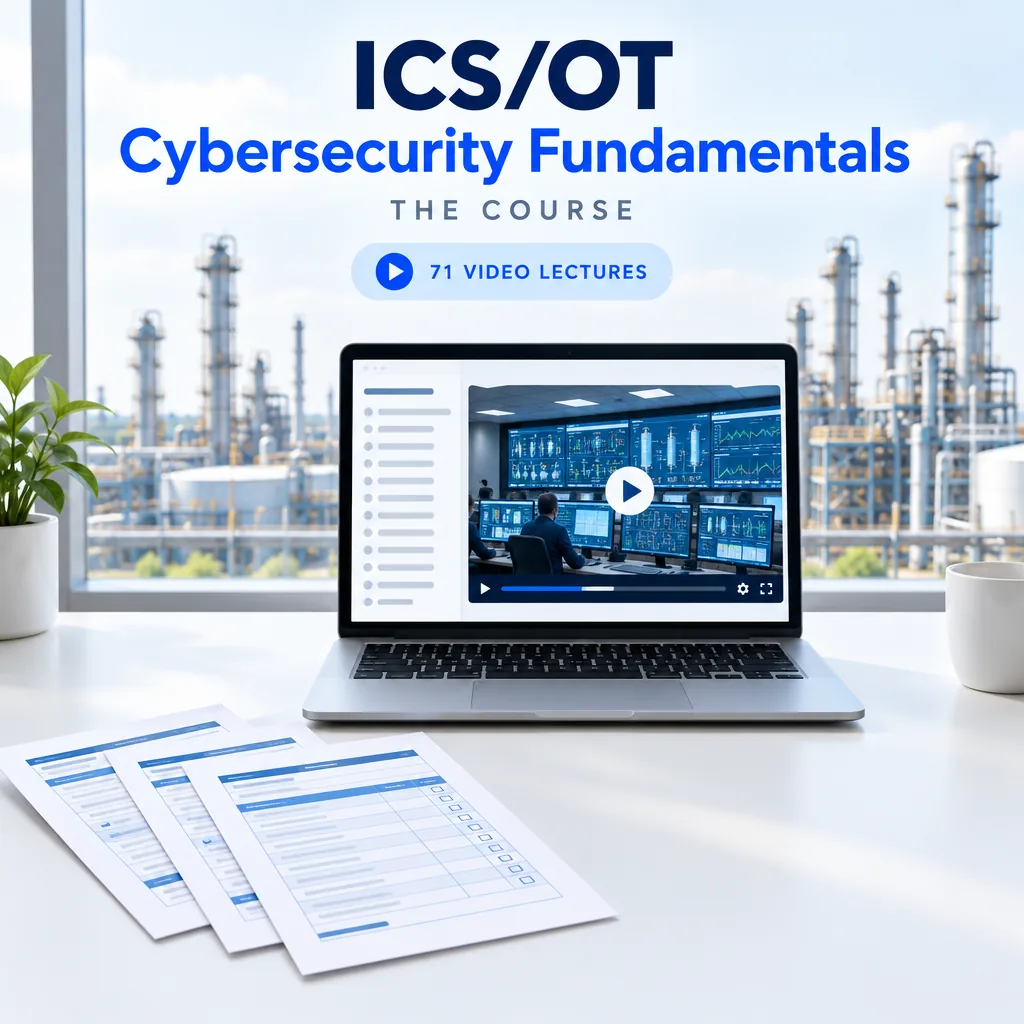
The full course, 24 downloadable tools, an IEC 62443 exam-prep section and a full-length prep test
Total value US$275
$197 USD one-time
Half price, only with this order
Already have an HKSM account? Use the same email at checkout and the course is added to it.Most plants are not exposed because nobody cares. They are exposed because of five beliefs that used to be true.
"We are not connected to the internet." Converters, remote vendor access and historians connect most plant networks to something, and the drawing from five years ago shows none of it.
"The firewall protects us." A firewall whose rules nobody has reviewed since commissioning is not a boundary.
"Attackers do not understand our systems." The tools to find exposed industrial devices are public, and Modbus was designed in 1979 with no authentication.
"We are too small to be a target." Ransomware groups choose plants because every hour of downtime has a price.
"Our systems would notice." Control systems detect process faults, not attackers. A malicious command looks like an operator's.
None of these started as a mistake. The technology, the tools and the attackers changed. The beliefs did not.
Control systems engineers and automation technicians handed ICS security responsibility, who need a foundation that works in an OT environment.
IT security professionals moving into OT, who know the frameworks but have never worked with industrial protocols or control systems.
Plant managers and operations leads who need to judge ICS cyber risk, approve security budgets and brief executives without relying entirely on vendors.
OT and operations staff preparing for an audit under NERC CIP, NIS2 or the TSA pipeline directives, who need to know what auditors expect.
Professionals moving into an ICS/OT security role who want the conceptual foundation before an industry certification.

You should know what a PLC, an HMI and SCADA are. No cyber security background is needed. New to industrial control systems? Start with our free Industrial Control Systems Introduction course, then come back. It is also linked inside your course access.
IT versus OT, the five myths, risk, defence in depth, IEC 62443 and NIST for ICS, with Stuxnet and Triton.
People and awareness, the five-level reference model, roles, governance and the asset model, with Industroyer.
Reference architecture, zones, conduits and security levels, a full SCADA design example, and Colonial Pipeline.
The cybersecurity lifecycle, program elements, maturity, what is mandatory and what is not, supply chain risk, and NotPetya.
Asset visibility and discovery, detecting threats in OT traffic, patching without stopping production, OT incident response, and the German steel mill.
Why industrial networks are vulnerable, firewall classes, defence in depth, IDS, IPS and data diodes, and DMZ architecture.
VPNs, secure remote access with jump servers and MFA, default credentials, and wireless in OT.
Modbus, OPC Classic, OPC UA, and PIPEDREAM, the malware that spoke to PLCs directly.
Defining the system under consideration, the risk equation, security level vectors, and turning risk into architecture with IEC 62443-3-3.
Service provider roles, evaluating providers against the twelve IEC 62443-2-4 areas, buying secure products, security profiles, and Dragonfly.
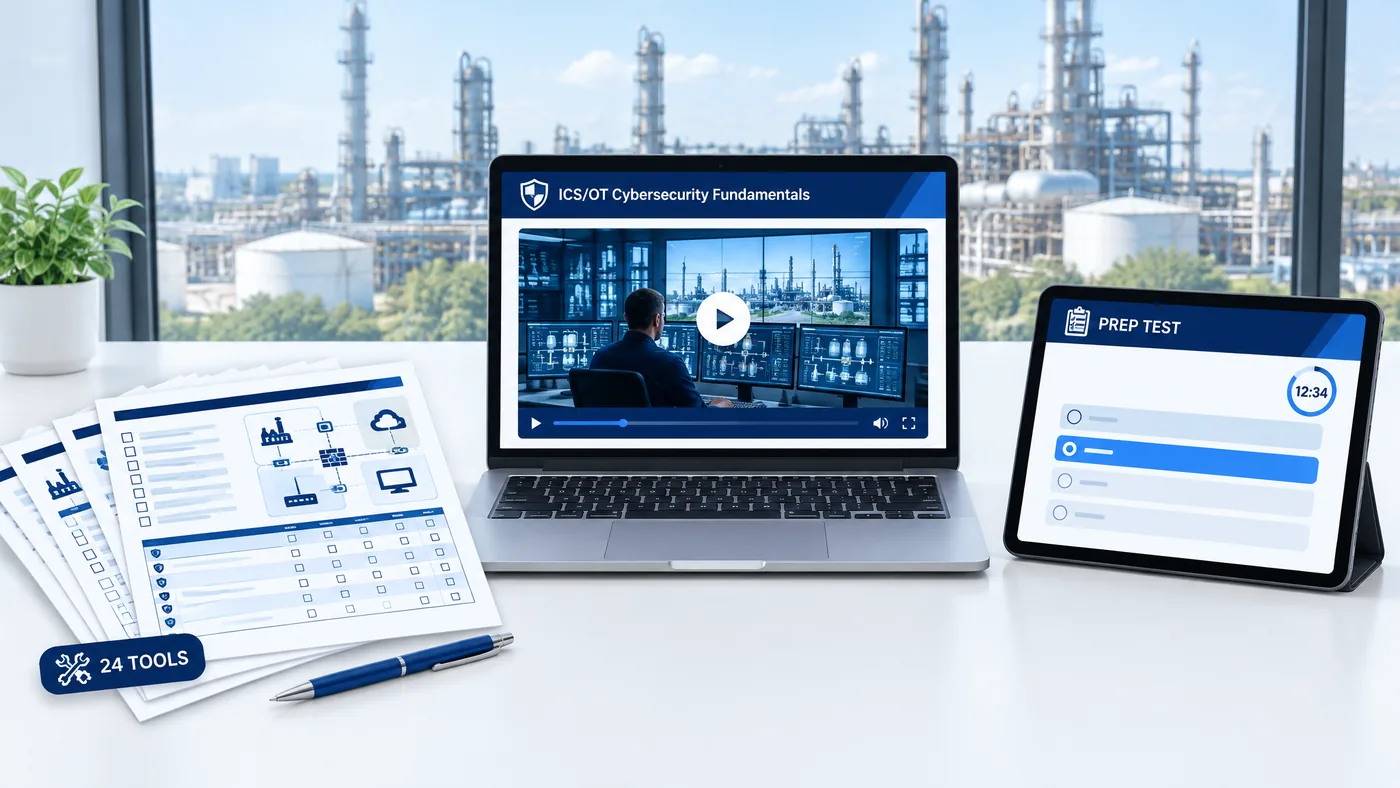
Eight short lectures on what IEC 62443 exams test: the lifecycle, the CSMS, the substandards, the ZCR workflow, the FR vector, compensating countermeasures and role mapping, with study aids on screen.
Stuxnet. Triton. Industroyer. Colonial Pipeline. NotPetya. The German steel mill. PIPEDREAM. Dragonfly. And more. Each is told in full, then traced to the specific control that would have broken the attack chain.
Total value: US$275
Your price: $197 USD One payment. No subscription.
Half price, only with this order
It is not a penetration testing or hacking course, and there is no lab with live controllers. If you already lead OT risk assessments every week, most of it will be familiar.
Take the course for 30 days. If it is not what you needed and you have completed half of the course or less, write to us through the Contact page and ask for a refund. You get your money back in full, no argument.
The risk is ours, not yours. The same terms are in our refund policy.
Read the Refund Policy and Terms and Policies. Questions? Contact HK School of Management and Technology.
No. The course explains every security concept in terms that work whether you come from the plant floor or from IT.
Yes, the basics: what a PLC, an HMI and SCADA do. If that is new, take our free Industrial Control Systems Introduction course first.
No course can. Compliance is decided against your whole program. The course explains what each regulation requires and which ones apply to which sectors, so you can take part in that conversation with substance.
It includes an exam-prep section that reviews what IEC 62443 exams test, with study aids on screen, and a full-length prep test of 70 questions you can take in practice mode or as a timed simulation. It does not certify you, and it does not replace the official preparation for any specific certification.
No. The course is video lectures, quizzes and downloadable tools. There is no PLC hardware, no SCADA software and no penetration testing.
Close to six hours of video, self-paced. You can work through a section at a time and come back when a real decision lands on your desk.
You are covered by our 30-day money-back guarantee. If you have completed half of the course or less, write to us through the Contact page within 30 days and we refund you in full.
No. One payment of US$197. No subscription.
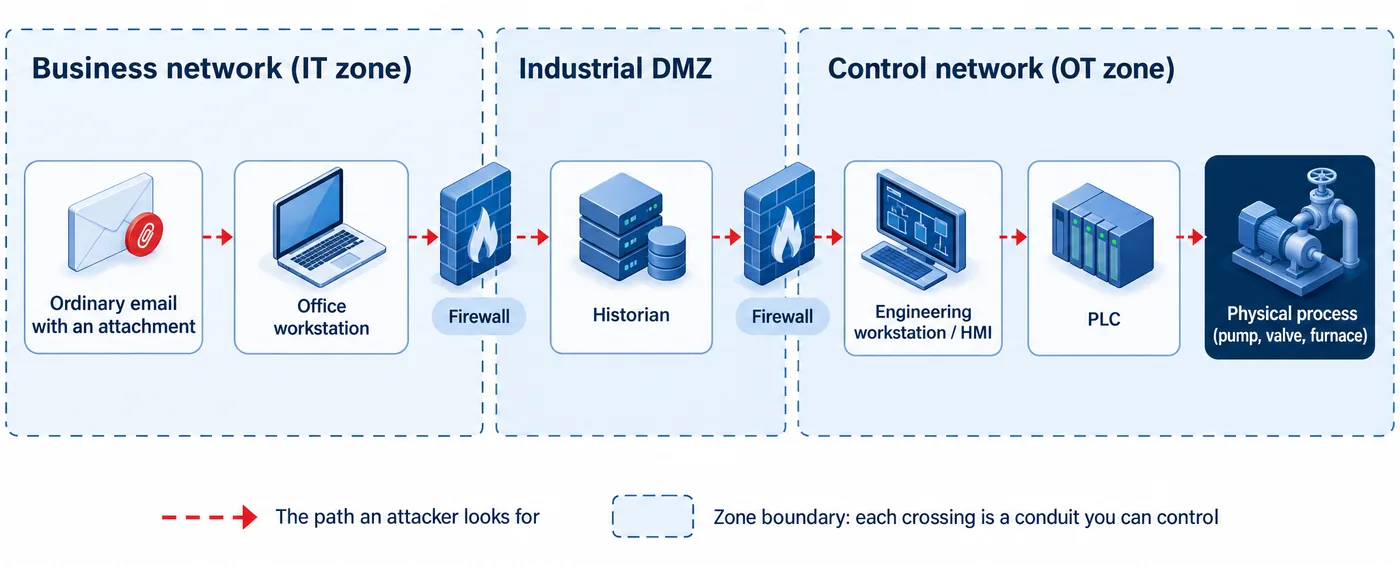
Somewhere on most plant networks there is a path from an ordinary email to a physical process. This course shows you how to find it, and how to close it.