

The last box in an IEC 62443-3-2 risk assessment is a signature. The person who ran the assessment is usually the wrong person to sign it, and the standard says so in plain terms. Assessors have the knowledge but typically lack the authority to accept risk. So the results go to the asset owner's managers who answer for the safety, integrity and reliability of the process.
Keep that box in mind as you read. Every step before it exists to give those managers something to decide on. That means a scoped system, an honest worst case, a zone map that follows risk, and a reasoned target security level for each zone. This guide walks the seven zone and conduit requirements (ZCR 1 to ZCR 7) in order, with the mistake that most often breaks each one. The free worksheet at the end follows the same sequence, page by page.
One example runs through the steps. It is made up, but the shape is common: a food plant with an ammonia refrigeration system. Two PLCs run it from an HMI in the engine room, with ammonia leak detection beside them. A contractor plugs in a laptop for tuning, and a vendor has remote access through a VPN.
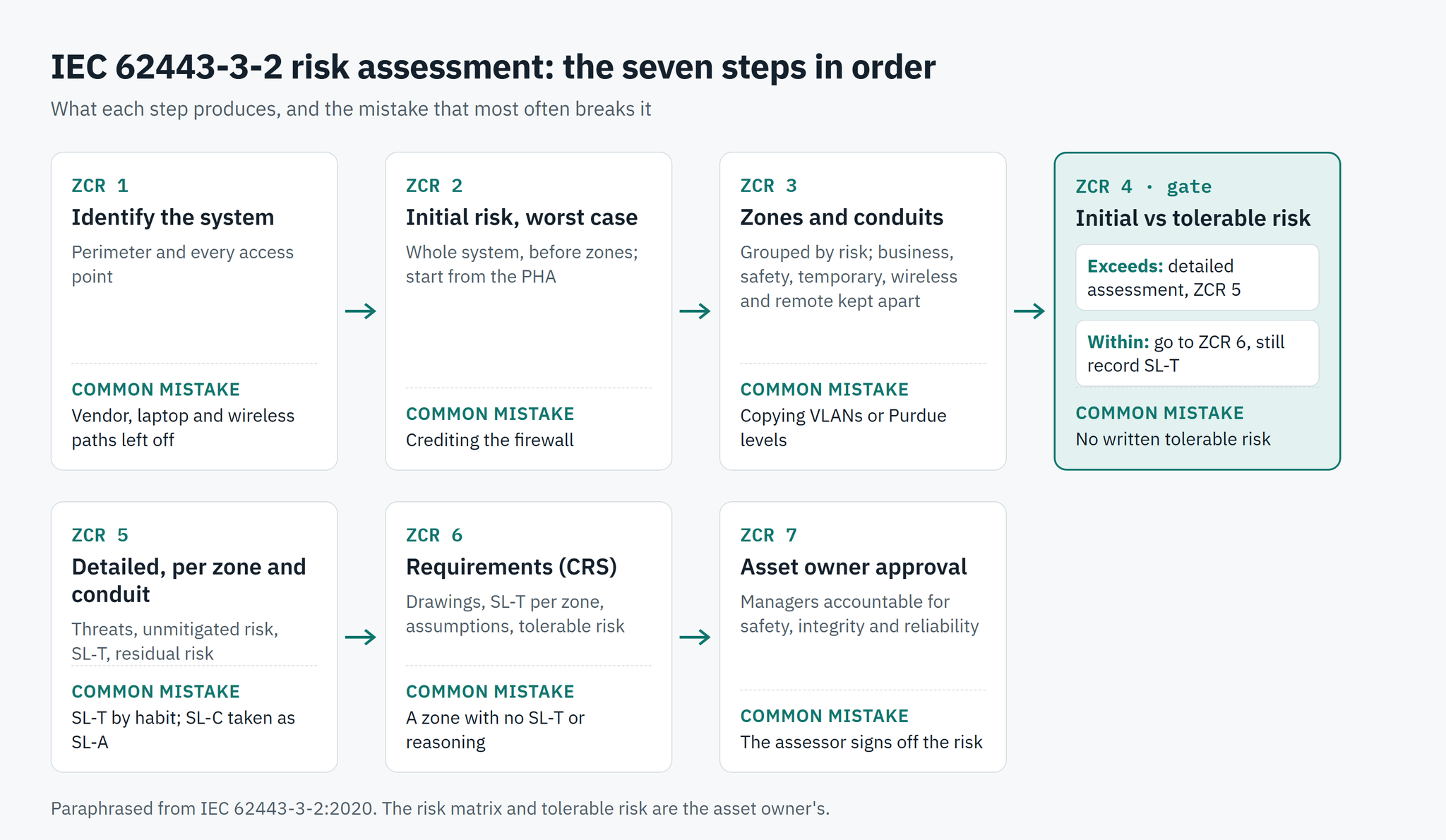
ZCR 1: draw the boundary, then list every way through it
ZCR 1.1 asks for the system under consideration (SuC): its security perimeter and every access point into it. The standard suggests the inventory, architecture diagrams, network diagrams and data flows as the evidence. A SuC can hold a BPCS, a DCS, a safety instrumented system, SCADA, supplier packages, and even IIoT or cloud services.
For the ammonia plant, the perimeter holds the two PLCs, the HMI, the leak detection panel, the emergency shutdown logic and the switch they share. The access points are where people go wrong. There is the plant network uplink, the vendor VPN, the contractor's laptop port, a wireless gateway on the condenser roof and the HMI's USB slot. A historian link to a cloud dashboard makes six.
Write down the version and date of every diagram you used. An assessment built on a two-year-old network drawing describes a plant that no longer exists.
ZCR 2: score the worst case, before any zones exist
ZCR 2.1 is the initial risk assessment of the whole SuC. The question is narrow: if this system were compromised, what is the worst-case unmitigated risk to the organization? Impact is judged across health and safety, environment, production, product quality, financial, legal, regulatory and reputation.
For a hazardous process, the standard points you to the process hazard analysis (PHA) and the functional safety assessment. They already describe the worst outcomes. For the ammonia plant, that is a release in an occupied building, scored as severe on health and safety before anything else. A common way to run this step is to assume the attack succeeds and score only the consequence.
The mistake here: crediting the firewall. Teams look at the existing defences and score the risk as low because "the PLCs sit behind a firewall." The step asks for unmitigated risk. Count the firewall now and the system can clear a ZCR 4 gate it should have failed. Then no zone gets an SL-T from a detailed, per-zone assessment. Existing countermeasures earn their credit later, at ZCR 5.8.
ZCR 3: let consequence draw the zones
ZCR 3.1 groups assets into zones (assets that share security requirements) and conduits (the communication channels between zones). The standard says risk decides the grouping. It can rest on the ZCR 2 results, or on criteria such as criticality, function, location, required access and the responsible team.
The next five requirements are where the zone map earns its keep:
| Requirement | What it says | In the ammonia example |
|---|---|---|
| ZCR 3.2 (shall) | Separate business assets from IACS assets | The office network and the production scheduling server sit outside the refrigeration zones |
| ZCR 3.3 (shall) | Separate safety-related assets; if they cannot be separated, the whole zone is treated as safety-related | Leak detection and the emergency shutdown logic get their own zone |
| ZCR 3.4 (should) | Put temporarily connected devices in their own zone | The contractor's tuning laptop and USB media |
| ZCR 3.5 (should) | Put wireless devices in their own zone; the access point is usually modelled as the conduit | The condenser roof gateway |
| ZCR 3.6 (should) | Put devices reached over external networks in their own zone | The vendor's remote session |
Two mistakes cluster here. The first is drawing zones before ZCR 2, usually by copying the existing VLANs. The leak detection panel then lands in the same zone as the HMI because they share a switch, and its consequence disappears into the average.
The second is treating Purdue levels as zones. The standard mentions the Purdue model as a common starting point for dividing a facility, so using it is fine. Stopping there is not. A Purdue level describes what a device does, not what happens when it is compromised, and two Level 1 controllers can carry very different consequences.
The quiet gap is the conduit nobody drew. The contractor laptop, the vendor VPN and the cloud historian link are all ways in. If they are missing from the map, the zone model has a side door, and every target set later assumes it does not exist.
ZCR 4: compare with a tolerable risk you wrote down first
ZCR 4.1 is a gate. Compare the initial risk from ZCR 2 with the organization's tolerable risk. If the initial risk exceeds it, a detailed assessment is required; if not, the standard's workflow moves straight to ZCR 6.
The mistake here: no tolerable risk. Many assessments reach this step with a risk matrix and no written statement of what the organization will tolerate. Then the gate becomes "everything Low skips ZCR 5," which is not the test. One site may tolerate Medium; another accepts nothing above Low for anything touching health and safety. The tolerable risk belongs to the asset owner and goes into the requirements document at ZCR 6.8. It needs to exist before you reach this gate.
The risk matrix belongs to the asset owner as well. IEC 62443-3-2 does not prescribe one. Its informative Annex B shows examples in several sizes, from 3 x 5 down to a simple 3 x 3 (Table B.4). The worksheet prints that 3 x 3 grid as an example only. Use the matrix your site already approves for safety and business risk. Otherwise the cyber assessment speaks a different language from every other risk decision in the plant.
ZCR 5: the detailed assessment, one zone or conduit at a time
When the gate sends you here, ZCR 5 applies to every zone and conduit. Similar zones can be analysed together, and a standardized design can reuse earlier results. Any method that meets the requirements is acceptable, and the standard names ISO 31000, NIST SP 800-39 and ISO/IEC 27005. Keep the same risk scale you used at ZCR 2.
The thirteen sub-steps reduce to four moves:
- Threats and weaknesses (ZCR 5.1 and 5.2). For each threat, describe the source, its capability, the vector and the assets it reaches. The standard's own examples are ordinary: a USB stick plugged into a control room computer, and a support person connecting with an infected laptop.
- Unmitigated risk (ZCR 5.3 to 5.5). Score consequence and likelihood with the existing cyber countermeasures removed on paper. One detail surprises people. The standard still lets you count non-cyber protection layers, such as pressure safety valves, physical security and emergency procedures, when you judge unmitigated likelihood. For the ammonia plant, a mechanical relief valve counts here; the firewall does not.
- The target (ZCR 5.6). Set the target security level, covered in the next section.
- Residual risk (ZCR 5.7 to 5.12). For each threat over tolerable risk, decide to accept, transfer or mitigate. Then credit the existing countermeasures, re-score, and compare the residual risk with tolerable risk. Where it still exceeds, accept, transfer or add countermeasures until it fits. ZCR 5.13 documents the results.
Setting SL-T without guessing
The standard says there is no prescribed method for setting SL-T. It describes three approaches organizations use. Some base SL-T on the gap between unmitigated and tolerable risk. Some map the threat to the security level definitions. Others start from a reasonable level, check the risk with that level's countermeasures in place, and raise it until the risk is acceptable.
Those definitions are short enough to keep beside you:
| Level | Protects against |
|---|---|
| SL 1 | Casual or coincidental violation |
| SL 2 | Intentional violation using simple means, low resources, generic skills and low motivation |
| SL 3 | Intentional violation using sophisticated means, moderate resources, IACS-specific skills and moderate motivation |
| SL 4 | Intentional violation using sophisticated means, extended resources, IACS-specific skills and high motivation |
You will often hear SL 4 called "nation-state." That is practitioner shorthand; the standard's wording is extended resources and high motivation. SL-T can also be a vector across the seven foundational requirements of IEC 62443-3-3. Its own example is SL-T(BPCS Zone) = { 2 2 0 1 3 1 3 }. The order runs FR 1 identification and authentication control, FR 2 use control, FR 3 system integrity and FR 4 data confidentiality. Then come FR 5 restricted data flow, FR 6 timely response to events and FR 7 resource availability.
The mistake here: SL-T by habit. "Everything is SL 2" skips the link between risk and requirement that the whole standard is built on. The leak detection zone may need SL 3 on system integrity and resource availability, and nothing like that on confidentiality. A blanket number hides both.
Two more terms get mixed up at this point. SL-C is what a component or system can deliver natively when properly configured: a property of the product. SL-A is the level actually achieved, measured on the design or on the installed system. A PLC with an SL-C of 2 does not make the zone around it SL 2. Where SL-C falls short of SL-T, IEC 62443-3-3 calls the fix a compensating countermeasure. One example is a monitored jump host in front of a controller that cannot authenticate users itself.
ZCR 6 and ZCR 7: write it down, then hand over the decision
ZCR 6 produces the cyber security requirements specification (CRS). It holds the SuC description and the zone and conduit drawings, with every asset assigned. It lists the characteristics of each zone and conduit, SL-T and access points among them. Then come the operating environment assumptions, the threat environment, the security policies, the tolerable risk and the regulatory requirements.
Note one consequence of ZCR 6.4: each zone's characteristics include its SL-T. If the system passed the ZCR 4 gate, each zone still needs a target on paper. Record the reasoning with it too; that is good practice, not a clause. The worksheet asks for both on that path.
ZCR 7.1 is the box from the opening paragraph. The asset owner's managers accountable for safety, integrity and reliability review and approve the results. The assessor recommends; the managers accept the risk.
Where the worksheet stops
The worksheet is a working template that follows the ZCR 1 to ZCR 7 sequence of IEC 62443-3-2:2020. The threat-by-threat scoring of ZCR 5.1 to 5.5 goes in your own risk register; page 3 records the outcome for each zone or conduit. It does not replace the standard, and it cannot tell you what your organization tolerates. The risk matrix, the tolerable risk and the method for SL-T are the asset owner's decisions. Where the worksheet prints an example, the owner's approved version wins.
It also stops at the assessment. It will not design the countermeasures, prove SL-A on the installed system, or keep itself current. Repeat the assessment when the system changes: a new remote access path, a new wireless link, a controller replaced with a different model.
Start with section A this week
Three pages, the same order as this guide. Page 1 covers the SuC and the worst-case score. Page 2 holds the zone inventory and the ZCR 4 gate, and page 3 is one security level and approval sheet per zone or conduit.
- Download the worksheet from the ICS/OT Cybersecurity Templates on the HKSM downloads page: hksmnow.com/downloads/?category=ics-ot-cybersecurity-templates
- Fill section A for one system. List every access point you can find. Done when the vendor, contractor and wireless paths are all on the page.
- Find your tolerable risk statement. Ask risk management or the safety lead for the approved matrix. Done when it is written in section B, or when the missing statement is logged as the first finding.
- Score ZCR 2 with no countermeasures credited. Use the PHA for the worst case. Done when the score has a named source next to it.
For the background behind each step, the ICS/OT Cybersecurity Fundamentals course teaches zone and conduit design and a structured OT risk assessment: hksmnow.com/courses/ics-ot-cybersecurity-fundamentals