

Walk out to the chiller on your plant roof and ask who owns its controller. Facilities will say IT set up the network. IT will say it belongs to the building. The OT engineer will say it is not part of the process, so it is not theirs.
NIST has now written that argument into its guidance. The draft fourth revision of its OT security guide, SP 800-82 Rev. 4, gives building automation its own section. In NIST's words, this kind of security "is often overlooked, primarily due to ambiguous governance responsibilities among facilities management, OT, and IT cybersecurity groups." That sentence sums up the whole revision for a small plant team. The draft adds a few new controls, but its real change is to who owns the risk, and to which systems count.
What NIST actually published, and what it has not
On 21 September 2026 NIST released the initial public draft of SP 800-82 Rev. 4, retitled "Guide to Operational Technology (OT) Security." It is a draft. Rev. 3, published in September 2023, stays the current final edition until NIST issues the finished Rev. 4, and the text below may change after public comment.
NIST's own note to reviewers lists the changes. These are the five that matter most to a plant:
- The OT sectors covered now include building automation and control systems (BACS), water and wastewater, food and agriculture, freight rail, maritime vessels, and Industrial IoT with cloud convergence.
- The guide is restructured around the NIST Cybersecurity Framework (CSF) 2.0, with the old risk management section rebuilt around the CSF Govern function.
- OT risk management is tied to enterprise risk management, following NIST IR 8286r1.
- Guidance on asset management and on network monitoring and detection is expanded.
- A new security architecture section covers protecting system management functions and applying zero trust principles.
Two housekeeping changes are planned for the final version. The threat and incident appendix and the list of OT security organisations move to web pages NIST can update more often. The OT overlay and the Risk Management Framework appendix become separate documents.
The building your plant sits in gets its own section
Rev. 3 already listed building automation as OT. The draft goes further. Five sectors now get their own section on architecture, challenges and recommendations: building automation, water and wastewater, food and agriculture, freight rail and maritime. For a manufacturer, the BACS section lands closest to home: HVAC, fire and life safety, lighting and electrical, physical access control and energy management are all named.
The draft's advice for buildings reads like a description of most plant sites. It calls for a shared responsibility model with a named owner of BACS security risk. It says to prioritise by subsystem criticality instead of applying the same controls everywhere, with safety-critical and regulated systems first. It also warns about commissioning, where default credentials and keys "are never changed before the system transitions to production." Improperly managed contractor laptops and unauthorized remote access systems turn up in the same phase.
What to do with it: add the building systems to your OT asset list, starting with fire and life safety and anything that controls the environment your process depends on. Then write one name next to each. If you share the building with a landlord or another tenant, the draft flags that too, so settle ownership of the BACS network in writing.
The food and agriculture section is aimed at farms and first handlers such as grain elevators. Food processing sites are pointed back to the manufacturing guidance. Its warning about platform dependence still applies to any site that runs on one cloud or software platform. Keep an offline fallback, such as manual grain receiving that keeps running through an outage.
Risk moves out of the engineering office and into Govern
This is the change a small team will feel first, because it is about meetings and signatures, not firewalls. Section 3 of the draft is titled "OT Risk Management and Governance (CSF 2.0 GOVERN)." It says OT risk "should not be managed as a stand-alone technical issue but as part of the organization's broader risk management processes."
In practice the draft asks for three things. Senior management sets up a charter for the OT cybersecurity program and names an OT cybersecurity manager with the authority to lead it. A shared governance group brings together leadership, OT, IT, safety, legal and operations. And OT risks are written into a risk register that feeds the enterprise risk process.
The register is the most useful part for a small site. Table 4 of the draft spells out its fields: priority, risk description, risk category, estimated likelihood, estimated impact, impact categories, combined exposure rating, chosen risk response, risk owner and status. The risk owner is responsible for "communicating the implications of their risk(s) to the ERM team." That puts a plant engineer's concern about an unpatched historian in front of the people who set budgets, in a format they already read.
The draft does not assume a large security team. It says organisations may hire staff, use contractors or buy OT security operations as a managed service. Whichever model you choose, OT security management should be integrated with IT security and enterprise risk management.
Zero trust is aimed at Level 3 and above, and the draft says why
Section 5.3 brings zero trust into the guide, and it is more careful than the headlines. It starts from a plain observation: "boundary protection devices between zones do not mitigate lateral movement risks within a zone." Your firewall between the plant and the office network does nothing about an infected laptop already on the plant side.
Then it draws a line. Many PLCs, controllers and HMIs "do not support the technologies or protocols required to fully integrate with a ZTA implementation," so organisations "should consider applying a ZTA to compatible devices," typically at Purdue Levels 3, 4 and 5 and the OT DMZ. The draft also asks you to check whether a zero trust component adds latency, and whether its outage would hit operations and safety.
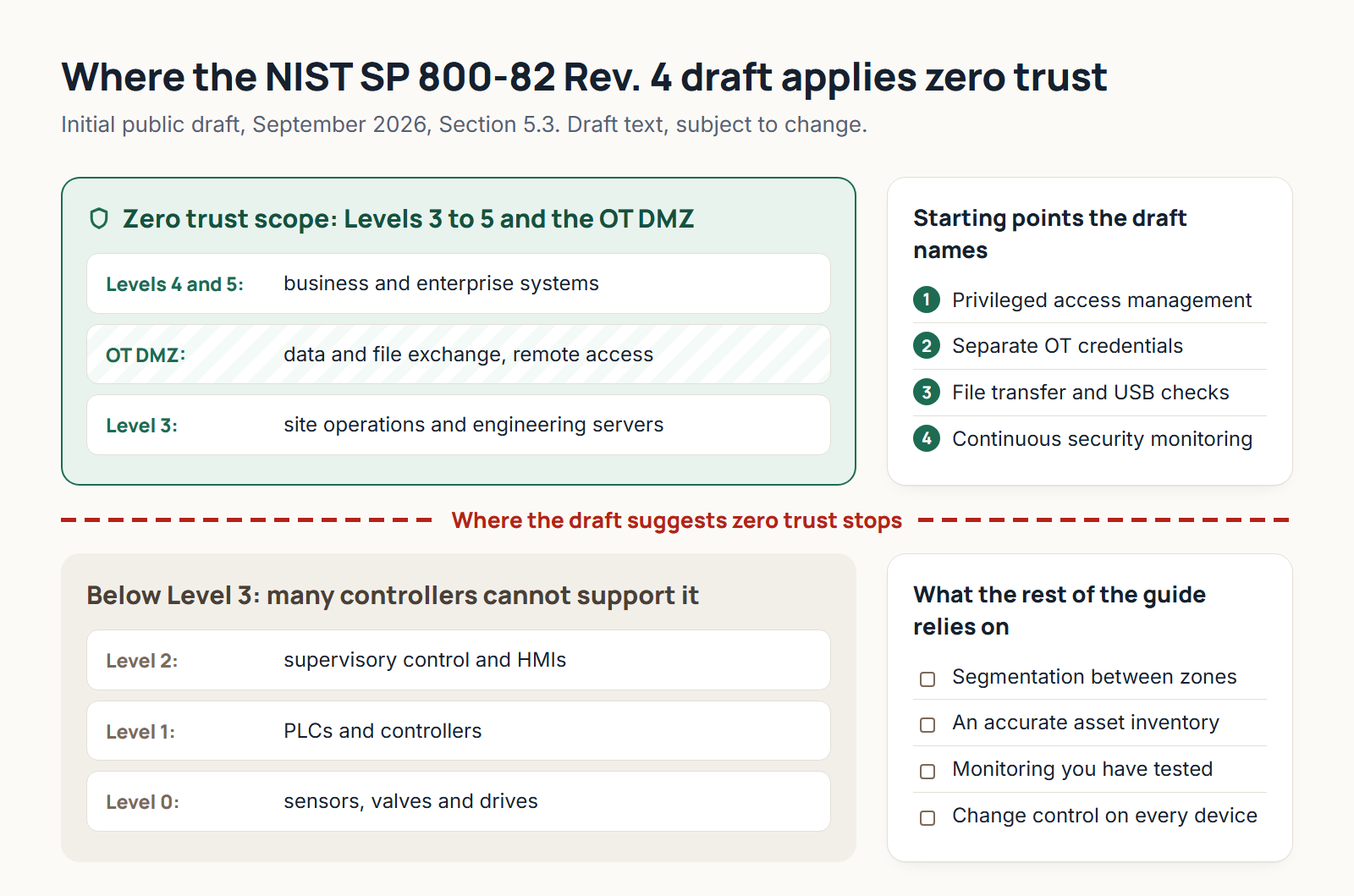
The part a small team can use is the list of controls the draft says already "embody core zero trust principles." It calls them a practical starting point "rather than requiring a separate initiative":
- Privileged access management. Each privileged session is authorised on its own, time-limited and can be cut off. The draft calls this "the clearest expression of zero trust."
- Separate OT credentials. A dedicated OT authentication server, so a stolen enterprise password cannot satisfy an OT access check.
- File transfer and removable media checks. Every file is scanned and validated, and quarantined if it fails, each time it moves in. Passing the USB kiosk once earns no lasting trust.
- Continuous security monitoring. It feeds the decision to revoke or adjust access while a session runs, not only at logon.
Below Level 3, the draft does not prescribe zero trust; protection there comes from segmentation, monitoring and the other controls elsewhere in the guide. Vendor commentary has already pushed on that line. Zscaler's analysis argues that stopping at Level 3 leaves controllers protected only at the zone boundary, which the draft itself says does not stop lateral movement. It proposes enforcing access decisions in the network in front of each device. That is a vendor position, written to promote its own products, not NIST's.
Inventory and monitoring get more practical detail
The expanded asset management section is worth reading even if you never touch zero trust. It lists what an inventory should hold. That means unique identifiers, hardware details and location, software and firmware versions with a software bill of materials, vendor contacts and end-of-life dates, and the people responsible for each asset. It also says to update the record whenever a component is patched, reflashed or swapped during maintenance.
It is candid about the tools. Vendor engineering tools give rich detail but usually read only one vendor's product line. Passive monitoring finds devices you did not know about, but it depends on sensor placement. The draft notes that much OT traffic can stay on "a single switch buried within the architecture," where a sensor never sees it. OT-aware active scanning covers several vendors, but the draft suggests consulting your vendors and says to test before running it on production.
What a small plant team should do this month
None of this needs the final document. Each step below follows the draft's own text and would hold up under Rev. 3 as well.
- Walk the building systems. List every BACS controller on site, mark fire and life safety first, and record default credentials you find. Done when each one has a named owner.
- Write five risk register rows. Use the draft's Table 4 fields for your five biggest OT risks, give each an owner, and send them to whoever runs enterprise risk. Done when they appear in the next risk review.
- Check where your OT logons come from. If engineers sign in to OT systems with their office domain account, write that down as a risk and price a separate OT identity source. Done when the decision is recorded, either way.
- Map your monitoring blind spots. Mark which switches your monitoring can and cannot see. Done when every unmonitored switch is on the risk register or covered by a sensor.
- Comment on the draft if you read this before 30 November 2026 (see the note at the end).
Where this guidance stops
The draft is a guide, not a regulation, and it is not final. It does not tell you how much to spend or which product to buy, and its zero trust section stops above the controllers that matter most to your process. For Level 2 and below, you still depend on the older basics: segmentation, an accurate inventory, monitoring you have tested, and people who know what normal looks like.
The draft's lasting change for a plant team is that an OT risk without a named owner is now a governance gap, not only an engineering one. Name the owners first; the controls follow.
How to comment on the draft (dated note, written 19 November 2026)
NIST set the comment period from 21 September to 30 November 2026. Comments go by email to sp800-82rev4@nist.gov, and NIST provides an Excel comment template, linked from the draft's page at csrc.nist.gov/pubs/sp/800/82/r4/ipd. All comments can be released under the Freedom of Information Act, so write nothing you would not publish.
The comments that change a draft are specific. Name the section and line number, say what does not work at a site like yours, and propose replacement text. A small plant's account of why a control is impractical at its size is evidence NIST rarely hears from large operators.
If you are reading this after 30 November, the same page will show the draft's status and, in time, the next version. Check there before you rely on any detail above.
If you want to go further on this, the ICS/OT Cybersecurity Fundamentals course covers zone and conduit design, building an asset inventory with passive monitoring, and a structured OT risk assessment at hksmnow.com/courses/ics-ot-cybersecurity-fundamentals.